In short
AV-over-IP spent the last decade fragmented across three open standards and one proprietary cluster. ISE 2026 was the inflection point: the AIMS Alliance announced the first 48 IPMX-certified products, making IPMX a certifiable multi-vendor standard, and AVIXA now advises writing IPMX certification into 2026 tenders. This article lays out what IPMX, SMPTE ST 2110, and SDVoE actually carry, where each one wins, and how to recognise the tender language that locks you into one of them.
The 2026 inflection point
AV-over-IP started as a wedge between two worlds. Broadcast facilities had SMPTE ST 2110 — a SMPTE-shepherded standard for uncompressed video (and, under ST 2110-22, compressed video), audio, and ancillary data over IP, with PTP-locked timing. Corporate ProAV had SDVoE — Software Defined Video over Ethernet, pushed by the SDVoE Alliance, built on Semtech's BlueRiver chipset, typically paired with a Marvell (formerly Aquantia) AQrate 10GBASE-T PHY. The gap in the middle — control rooms, NOC and SOC operations, corporate AV, education, situation centres — relied on NDI or proprietary KVM-over-IP, neither of which is a true open standard with multi-vendor certification.
IPMX (Internet Protocol Media Experience) targets exactly that gap. It is built on the SMPTE ST 2110 family — same packet formats, same NMOS management plane — but modified so it runs on the cables ProAV already owns: 1 GbE, optional PTP, native HDCP. AIMS certified the first 48 IPMX products at its Geneva testing event and announced them at ISE 2026; the vendors include Cobalt Digital, Matrox and Evertz.
No published forecast yet quantifies how many control-room and situation-centre procurements will require IPMX plus NMOS in the technical specification; our recommendation is to treat that combination as the default for new builds. Spec'ing the wrong standard now means either re-doing the build in 2028 or living with vendor-locked stacks the buyer was explicitly trying to avoid.
What each standard actually carries
SMPTE ST 2110 — the broadcast standard
ST 2110 is not a single protocol. It is a suite — ST 2110-10 for system timing, -20 for uncompressed video, -21 for traffic shaping and delivery timing, -22 for compressed video, -30 for audio, -40 for ancillary data — that splits a media stream into separate IP flows locked to a common PTP clock (IEEE 1588). The whole point of the split is that broadcast facilities can mix and match: route the audio one way, the video another, and recombine downstream without re-encoding.
Video in ST 2110-20 is uncompressed, which is the standard's biggest strength and its biggest cost. A single 4K60 stream eats about 12 Gbit/s of network capacity. That forces 10 or 25 Gigabit Ethernet end to end, plus switches with strict QoS, PTP boundary clocks, and enough port density to handle the source count. The total infrastructure cost rises quickly as the source count grows.
Adoption keeps growing in broadcast. The Haivision Broadcast Transformation Report 2025 surveyed nearly 900 industry professionals across 110 countries, and the 2026 edition (more than 1,300 respondents) found 30% of respondents using ST 2110, up from 26% in 2025, while 82% still rely on SDI infrastructure. Greenfield broadcast builds default to ST 2110; replacing legacy SDI routers with ST 2110 is the standard refresh path.
SMPTE ST 2110 update 2026: standard evolution and the ProAV question
The SMPTE ST 2110 suite continues to evolve through SMPTE working-group amendments. Recent updates focus on three directions: (1) tightening interoperability between vendors via NMOS IS-04 / IS-05 discovery and connection-management alignment, (2) maturing the ST 2110-22 mezzanine path so JPEG XS-encoded video can ride the same fabric without the full uncompressed 12 Gbit/s per 4K stream cost, and (3) clarifying security and timing guidance for facilities migrating from SDI in steps rather than greenfield.
For ProAV, control-room, and video wall buyers tracking SMPTE ST 2110 updates in 2026, none of these changes address the standard's structural cost: 10 or 25 GbE end to end for uncompressed flows, PTP boundary clocks at every switch, no NAT traversal, and a per-port density that scales linearly with source count. The 2026 standard is more interoperable and slightly more efficient than 2023-era deployments, but the entry-cost floor — the switching and timing infrastructure that must be in place before any source equipment is purchased — has not changed. For most non-broadcast use cases this remains the deciding factor that pushes buyers toward IPMX (the ST 2110-derived ProAV profile covered next) or away from IP-based media transport entirely.
SDVoE — uncompressed or visually lossless video for sub-frame latency
SDVoE is the chipset-defined alternative. Every certified endpoint — encoder, decoder, transceiver — runs the same Semtech BlueRiver chipset, typically paired with a Marvell AQrate 10GBASE-T PHY. The transport is 10 GbE: HD and 4K30 travel fully uncompressed, 4K60 4:4:4 uses a fixed, visually lossless 1.4:1 compression, and end-to-end latency stays under a single video frame. USB, serial, and audio ride alongside the video over the same link, so SDVoE doubles as a KVM-class fabric where it is deployed.
The fabric is simpler than ST 2110 by design. There is no PTP requirement — endpoints synchronise via the chipset itself. The control plane is proprietary to the SDVoE Alliance, and while some vendors layer NMOS on top, NMOS is not the canonical management path. This makes SDVoE faster to commission than ST 2110 and harder to mix with non-SDVoE gear.
The cost story is also simpler and steeper. Switches must be 10 GbE throughout; SDVoE endpoints sit at a premium relative to NDI or H.264-based AV gear because the chipset licensing flows through. For workflows where sub-frame latency end-to-end is a hard requirement — trading floors, military command and control, some live production — that price is the table stake. Outside those workflows, the premium does not always pay for itself.
IPMX — ST 2110 adapted for ProAV
IPMX keeps the ST 2110 packet structure and the NMOS management plane but changes three things that matter for ProAV deployments:
- JPEG XS compression. Visually lossless, low latency (single-frame end to end), and roughly 10× the bandwidth efficiency of uncompressed ST 2110. A 4K60 stream drops from ~12 Gbit/s to roughly 1 Gbit/s, which fits on standard 1 GbE switches.
- PTP becomes optional. IPMX endpoints can run without a facility-wide PTP grandmaster, which removes the single most expensive piece of ST 2110 infrastructure. PTP is still available when synchronised playback across a wall demands it.
- Native HDCP. Commercial HDMI sources — set-top boxes, BD players, console outputs, copy-protected production gear — flow through the fabric without bridging. ST 2110 has no native HDCP path; SDVoE handles it via chipset; IPMX puts it in the standard itself.
Management on IPMX is NMOS IS-04 for discovery and IS-05 for connection control, both mandatory. This is the same NMOS that some ST 2110 broadcast facilities run, which means the two standards interoperate cleanly at the control plane. A facility can run ST 2110 in the master control room and IPMX in the adjacent operations spaces without building two management universes.
Side-by-side
| Property | SMPTE ST 2110 | SDVoE | IPMX |
|---|---|---|---|
| Transport network | 10/25/100 GbE | 10 GbE only | 1 GbE and up |
| Video payload | Uncompressed (ST 2110-20); compressed, e.g. JPEG XS (ST 2110-22) | Uncompressed to 4K30; light 1.4:1 compression at 4K60 4:4:4 | JPEG XS (visually lossless) |
| End-to-end latency | Sub-frame | Sub-frame | Sub-frame to single frame |
| PTP synchronisation | Mandatory (IEEE 1588) | Not used (chipset sync) | Optional |
| Discovery | NMOS IS-04 (recommended) | Proprietary | NMOS IS-04 (mandatory) |
| Connection management | NMOS IS-05 (recommended) | Proprietary | NMOS IS-05 (mandatory) |
| HDCP | Not in standard | Native via chipset | Native in standard |
| Switch requirements | Multicast L3, IGMP querier, PTP boundary clock, strict QoS | 10 GbE, IGMP, multicast | Standard Ethernet, IGMP |
| 2026 tender presence | Default for broadcast | Niche for low-latency operator workflows | Rising in ProAV / control room |
| Vendor diversity | High (broad broadcast vendor base) | Constrained by chipset licensing | Growing (48 certified at launch, more in pipeline) |
The honest summary of that table: ST 2110 sets the broadcast bar, SDVoE sets the low-latency operator-control bar, and IPMX sets the bar for everything else that wants open multi-vendor AV-over-IP without either of those infrastructure commitments.
When each one is the right answer
Pick ST 2110 when
The build is a broadcast facility (greenfield or refresh), the existing partners are SMPTE-aligned (Grass Valley, Sony, EVS, Imagine Communications, Lawo, Riedel), and the budget can absorb 10/25 GbE switches plus PTP infrastructure. If a sports OB truck or a master control room is on the BOM, ST 2110 is the default choice. Trying to substitute IPMX in a full broadcast facility means losing the uncompressed-video guarantee that broadcast-grade colourists and editors rely on.
Pick SDVoE when
A sub-frame end-to-end latency is the single non-negotiable requirement and the environment is small enough that the BlueRiver chipset premium is acceptable. Classic fits: financial trading floors with time-sensitive operator action; some military command-and-control rooms; live production environments where the operator's cursor must feel attached to the source PC. The price tag and the chipset lock-in are the real reasons SDVoE does not win bigger control-room bids.
Pick IPMX when
Most other ProAV control rooms, NOC and SOC builds, situation centres, higher-education AV networks, and large corporate AV estates fit IPMX better than either of the alternatives. Specifically:
- New build or refresh in 2026-2028 where the buyer wants an open standard but cannot justify 10/25 GbE everywhere.
- Mixed AV-and-IT infrastructure on the same Ethernet backbone, with standard switches the IT team already knows how to manage.
- Tender language calling out NMOS IS-04/IS-05 management. IPMX is the only AV-over-IP standard where NMOS is mandatory rather than optional.
- Workflows that need HDCP from commercial sources without an out-of-band copy-protection bridge.
- Procurements explicitly trying to avoid chipset lock-in or single-vendor stacks.
The honest caveat for IPMX in 2026: the vendor pool is smaller than ST 2110. The certified list — 48 products at ISE 2026 and 14 more in August 2026 — is enough for most bids, but a tender that requires niche gear (specific encoder models, exotic I/O formats) may still need ST 2110 or SDVoE as the practical answer until the IPMX certified list grows.
The 2026 tender shift in numbers
Three data points anchor where the category is heading:
- 48 certified products at ISE 2026. AIMS announced the first 48 certified products at ISE 2026 after its Geneva testing event; Cobalt Digital, Matrox and Evertz are among the vendors whose products passed.
- IPMX certification written into tenders. AVIXA advises writing "IPMX certified" into 2026 tenders; no published forecast yet quantifies what share of control-room procurements will require IPMX plus NMOS.
- NMOS becomes a separate line-item in tender language. ProAV tenders in late 2025 already started listing NMOS IS-04 and IS-05 as required deliverables, often independent of the underlying transport. That language signals a deliberate move away from proprietary control planes — which IPMX satisfies natively and SDVoE does not.
Cross-referenced against the broadcast side: ST 2110 stays default for new broadcast facility builds (the Haivision survey figures above show ST 2110 use still growing), and that is not changing. The shift is at the boundary between broadcast and ProAV — where the two used to share nothing and now share the NMOS control plane through IPMX.
A practical decision tree
Strip the previous sections down to four questions, in order:
- Is this a broadcast facility (master control, OB truck, sports production, news studio)? If yes, spec ST 2110. The rest of the tree does not apply.
- Is sub-frame latency end to end an absolute hard requirement, and is the endpoint count small enough to absorb the chipset premium? If yes, look at SDVoE. Validate the chipset premium against the budget before committing.
- Does the tender call for NMOS IS-04/IS-05 or open multi-vendor AV-over-IP? If yes, spec IPMX. ST 2110 is overkill for this language, SDVoE does not satisfy NMOS natively.
- Does the project run on standard 1 GbE IT infrastructure already? If yes, IPMX again. ST 2110 forces a network refresh you may not need.
If none of those questions returns "yes", the project likely does not need a SMPTE-family transport at all — NDI or H.264 streaming over standard switches is usually the right answer, and the cost story stays cleaner.
Where Craft Wall fits
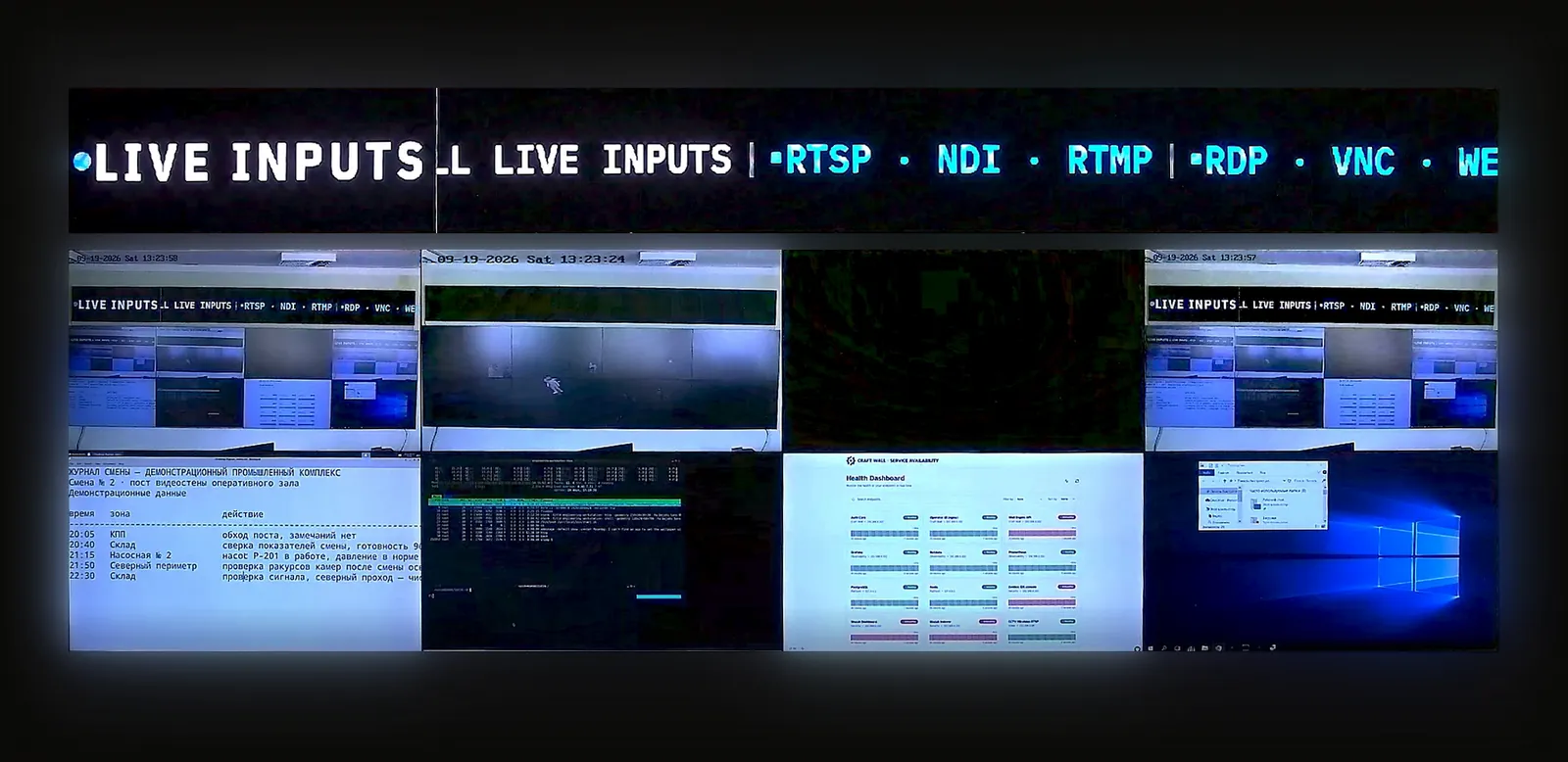
Craft Wall is the software composer above the transport layer — the engine that takes whatever sources arrive over the network and lays them out on the wall. Today the supported source mix is IP cameras and AV-over-IP streams over RTSP, RTMP, HLS and SRT, NDI (full and HX), HDMI and SDI capture, web pages and dashboards, RDP/VNC remote desktops, SIP/H.323 conferencing, documents and video files; the HDMI output of an IP-KVM receiver is captured like any other HDMI source. IPMX is not among the native source types; an IPMX feed reaches the wall through a certified IPMX decoder and HDMI/SDI capture.
Two things matter for any IPMX-related procurement decision involving Craft Wall:
- Because Craft Wall sits above the transport, the IPMX vs ST 2110 vs SDVoE decision happens at the encoder / decoder layer, not at the composer. The same Craft Wall installation shows a decoder-fed IPMX source next to NDI and RTSP streams.
- Standard Linux hardware means no chipset lock-in at the wall controller tier. The IT budget for the composer stays on a Linux server with an NVIDIA GPU, regardless of which AV-over-IP standard the encoders speak.
If a tender requires IPMX-conformant encoders today, the right path is to spec certified IPMX gear (from the AIMS product registry) at the source side and bring the decoder outputs into Craft Wall through HDMI/SDI capture. The composer layer is the more flexible piece of the stack — switching wall software is cheaper than switching transport.
Closing
AV-over-IP in 2026 is not "pick the winner" — it is "match the spec to the room". ST 2110 owns broadcast. SDVoE owns sub-frame latency at moderate scale. IPMX is the open standard for everything else, and the 2026 tender shift is real enough that buyers who ignore it now risk re-doing the build in 2028. The safest default for a new control-room procurement is IPMX plus NMOS, with a clear escape valve to ST 2110 if any part of the facility crosses into broadcast.
Read next: IPMX, NMOS, SMPTE ST 2110, SDVoE glossary entries, or the Craft Wall vs VuWall TRx comparison for how this transport question plays out at the wall-management tier.