In short
The video-wall category quietly stopped being about screens in 2025. The current product moves — Userful's Infinity EdgeAI (announced with Microsoft in September 2025), Visiology's analytics platform in the Russian market, and a quiet but accelerating list of in-house projects from Hiperwall, VuWall and Polywall — reframe the wall as an inference layer that happens to drive displays. The product question is no longer "how many sources can it render", it is "what does the wall actually notice for the operator". This article lays out what AI-augmented walls ship today, the architecture that runs underneath, why on-prem inference is the only path that survives compliance review, and where most of these deployments actually fail in production.
What "AI-augmented" actually means on a wall
Strip the marketing language and there are four concrete features that the term covers. Everything else is either one of these four with a different label or a roadmap promise that has not shipped.
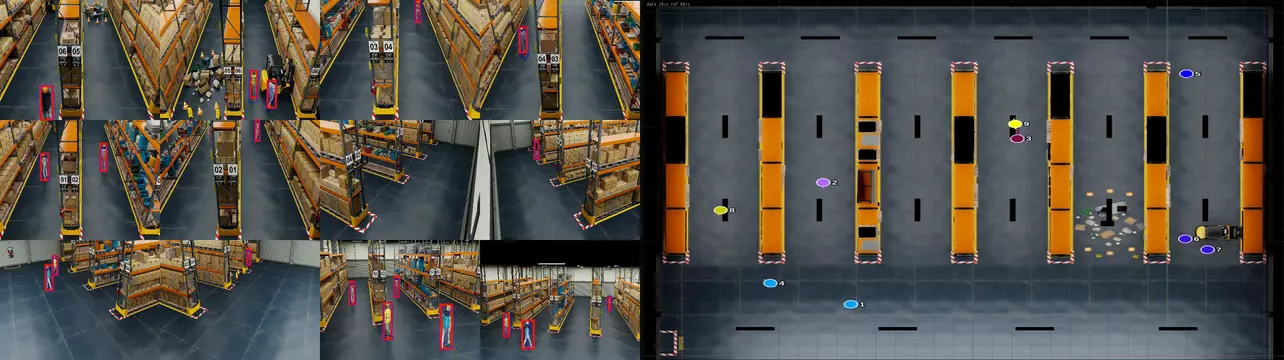
- Anomaly detection on live streams. A model — typically something in the YOLO v8 / v9 family for object detection, or a smaller time-series anomaly detector for dashboard sources — runs on each ingested stream and emits a confidence score. The wall controller subscribes to those scores and can react when they cross a threshold. Common in transport hubs, perimeter security, and energy SCADA dashboards.
- Source promotion (auto-layout switching). When a detection fires, the corresponding tile grows, moves to a centre region of the wall, and stays there until an operator acknowledges or the detection clears. The layout engine has to support both soft transitions (animated pin / zoom) and hard cuts (instant reorganisation) — operators react differently to each.
- Object counting and dwell metrics. Face count for crowd-density rooms, vehicle / licence plate counts for traffic, queue length for retail. The output is usually a number overlaid on the source tile or pushed to a sibling dashboard rendered by the same wall.
- Cross-source correlation. The newest tier: feed several sources into a single inference pipeline and emit a single "situation score" that drives the wall layout. Userful's Infinity EdgeAI demos this with Splunk Enterprise Security + a VMS feed + a building-management telemetry source unified into one pane. The maturity is honest about this being early — most real deployments stay at single-source anomaly detection in 2026.
The current category benchmarks
Three products set the category bar in 2026, each with a different bet.
Userful Infinity EdgeAI is the most visible. Announced in September 2025 as a preview co-developed with Microsoft (Azure IoT Edge for model deployment), with Azure Marketplace availability from 2026, it builds on Userful's NVIDIA Inception partnership. The positioning is "operations awareness platform" — Userful is deliberately moving the product away from "video-wall software" framing into a higher-margin category. Integrations land on Splunk Enterprise Security, Genetec Security Center, Microsoft Sentinel, Everbridge CEM. Pricing follows the same Enterprise Subscription model the rest of Userful uses — the City of Austin contract prices the platform at $42 per display per month (about $504 per display per year) plus a $13,014 setup fee, before any EdgeAI charges.
Visiology is the Russian peer: its analytics platform is installed on-premises, which fits the Russian compliance environment (152-FZ, 187-FZ critical-infrastructure rules). Confirm which models it supports and how they are updated before you compare it with an open model stack.
Hiperwall, VuWall, Polywall sit in the same conversation but with narrower current shipments. Hiperwall's 2026 R1 release added "on-prem operator chat" (an internal collaboration tool, not inference itself) and broader Intel GPU support. VuWall and Polywall reference AI integrations through their NMOS-aware TRx / Polywall stacks. None of these has the depth that Userful's EdgeAI marketing currently claims; whether that gap holds through 2027 is the real category question.
The architecture underneath
Strip the brand layers and the runtime stack converges on three pieces.
- The model. YOLO v8 (Ultralytics) and v9 (developed by Academia Sinica researchers, also packaged by Ultralytics) are the default for object detection — they hit a usable accuracy / latency point on commodity NVIDIA GPUs. Check the licence: the Ultralytics package is AGPL-3.0 and the original YOLOv9 code GPL-3.0, so a closed commercial product normally needs an Ultralytics Enterprise Licence or a permissively licensed model. For more specialised use cases — face count, plate recognition, weapon detection — the model picks up specialised heads but the inference structure stays similar.
- The runtime. ONNX Runtime (see edge AI for video walls) is the lingua franca: vendors export their PyTorch / TensorFlow model to ONNX format, then run inference through the framework-agnostic runtime. The two backends that matter for wall hardware: NVIDIA TensorRT for RTX-class GPUs (≈ 3-5× speedup over plain ONNX Runtime), and Intel OpenVINO for integrated Iris Xe and discrete Arc GPUs. Both backends accept the same ONNX file, so the production model switch from NVIDIA to Intel is a deployment-time decision, not a retraining one.
- The orchestration. Microsoft Azure IoT Edge is the current default for "deploy this container with this model to this wall controller from a central place". For on-prem deployments without an external orchestrator, Kubernetes (k3s on the wall host) covers the same ground with more setup effort. The pattern is to containerise each model and let the orchestrator pin containers to available GPUs.
Sizing follows a rough rule of thumb that holds across most published deployments: a single RTX A4000-class GPU absorbs YOLO-class detection on 8 to 12 simultaneous 1080p streams with the wall's rendering workload still fitting alongside. RTX A5000 / A6000 roughly doubles that. Above ~20 streams the AI workload starts competing with the compositor's GPU work, and the right architecture is a separate inference node alongside the wall controller, feeding scores back through a message bus instead of running on the same GPU.
The on-prem requirement is not negotiable
Every serious procurement for a wall with AI lands on the same hard line: the live video can not leave the facility. Three regulatory frames force this.
- GDPR (EU). Cameras recording identifiable individuals produce personal data under Article 4(1). Sending that data to a third-country cloud inference endpoint requires a documented transfer mechanism (for US providers, the EU–US Data Privacy Framework or standard contractual clauses), which many facilities prefer not to depend on for live video. The clean answer is "the inference runs on-prem, the cloud only sees metadata if anything".
- FZ-152 and FZ-187 (Russia). Personal-data localisation and critical-infrastructure rules respectively. Russian state customers and most energy / transport facilities must run inference in-country, often on-site. Visiology's bet on bundled on-prem inference is built for this constraint specifically.
- FedRAMP / DoD IL5+ (US federal). Cloud AI for controlled unclassified data needs a provider-held FedRAMP authorisation, plus a DoD IL4 or IL5 authorisation for defence data, while classified facilities (IL6) run on separate classified networks such as SIPRNet. On-prem inference, with models deployed inside the facility's own network, is the default expectation.
The architectural takeaway: the AI part of an AI-augmented wall is not a cloud feature you bolt on with an API key. It is a model file shipped to the wall controller and a runtime sitting next to the compositor. Vendors that hide cloud inference behind a glossy demo lose the sale at the compliance step.
Where these deployments actually break
The model is rarely the failure point. Three operational problems are. Anyone repositioning a vendor as an AI-walls company needs an answer to each.
- False positives erode operator trust faster than the model improves. A wall that promotes the wrong tile to the centre three times in a shift gets ignored on the fourth promotion — the real one. The standard mitigation is two thresholds: a "show a small indicator on the tile" threshold and a separate, higher threshold for actual layout disruption. The product has to give the operator a clear way to adjust both.
- Model drift is silent until it isn't. A people-counter tuned on summer training data starts under-counting heavy winter coats by November. A vehicle detector tuned on European plates degrades in the Middle East. The product needs a monitoring layer — false-positive rate over time, manual override count — that gives the integrator a way to notice drift before the customer does.
- Audit trail for promoted tiles is non-negotiable for regulated buyers. When the wall promoted Camera 17 to the centre for 42 seconds at 14:03:17, what was the score, what model version produced it, what operator acknowledgement followed? Most compliance reviewers want this answerable. Vendors that have an answer ship in regulated facilities; those that do not stay in corporate AV.
Where Craft Wall fits
Craft Wall runs video analytics on the server GPU. The same on-prem Linux server with an NVIDIA GPU that drives the wall processes the camera streams, and the results are displayed on the wall alongside the cameras and dashboards they relate to, so the video never leaves the facility and no cloud inference service is involved. How many streams one server can analyse while it keeps rendering the wall depends on stream resolution, frame rate and the analytics workload, so the GPU is sized for each project rather than read off a fixed stream count.
The honest closing
AI-augmented video walls are not a product category yet — they are a deployment pattern that one vendor (Userful) is currently best at articulating and a second (Visiology) is best at delivering inside a single regulatory regime. Most other vendors will get there in 2026-2027. The buyer question is not "which AI-walls vendor is best", it is "which use case actually justifies inference on the wall, and does our infrastructure already support it". Anomaly detection on a 12-camera perimeter is a clean fit. Cross-source correlation across SIEM + VMS + BMS is the marketing demo most facilities will not run for another two years.
Read next: Edge AI for video walls glossary entry, IPMX vs ST 2110 vs SDVoE for the transport question underneath, and the Craft Wall vs Userful comparison for how the AI piece fits in a competitive evaluation.