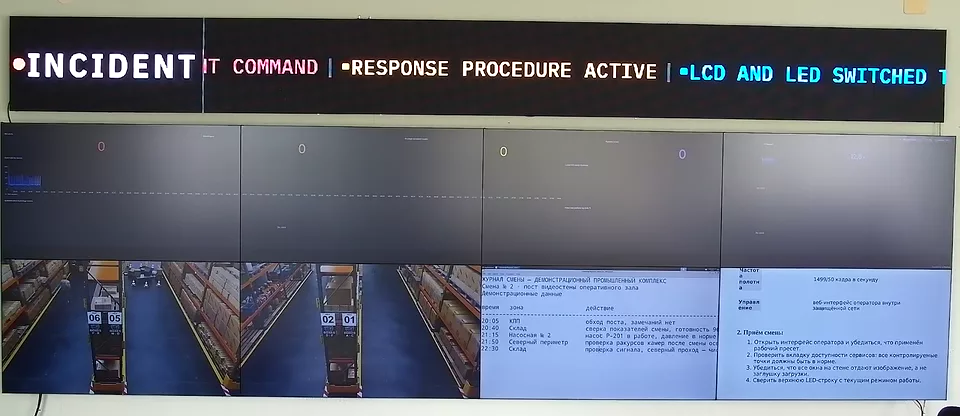
In short
Crisis management rooms — municipal, regional, and national Emergency Operations Centres (EOCs), corporate Incident Response (IR) rooms, public safety consolidated dispatch, healthcare mass-casualty coordination, cyber incident response — share the physical wall format with NOCs and transport ops, but the operating model is structurally different. Activation is event-driven, not continuous. Multiple agencies coordinate under a single command structure. Decisions are made with incomplete and sometimes contested information. Command frameworks (NIMS / ICS in the US, JESIP and the Gold–Silver–Bronze command structure in the UK, national equivalents elsewhere) shape the organisational structure that uses the wall. This article maps how that difference shows up in wall procurement and where software-defined walls appropriately fit.
What "crisis management room" actually covers
The phrase covers a wider operational range than the others in this use-case series. The common architectural elements are activation-driven operation, multi-agency coordination, and an explicit command-and-control structure running the room during an event.
- Municipal / regional EOC. City, county, or regional emergency operations centre, activated for natural disasters, large public events, mass-casualty incidents, critical infrastructure failures. Hosts representatives from police, fire, EMS, public works, transportation, public health, mass communications, and elected official staff during activation.
- State / national EOC. FEMA Regional / National Response Coordination Centres in the US, Cabinet Office Briefing Rooms (COBR) in the UK, equivalent structures elsewhere. Activated for larger-scale events that exceed local capability or involve cross-border coordination.
- Consolidated public safety dispatch / fusion centre. Combined PSAP (Public Safety Answering Point) plus dispatch plus intelligence fusion. Examples include the LA Joint Regional Intelligence Center pattern, state-level fusion centres, metropolitan PSAP consolidations.
- Corporate Incident Response (IR) room. Activated during cyber incidents, ransomware events, supply-chain disruptions, product-safety incidents, executive crises. Often smaller, but with comparable engineering rigour.
- Healthcare mass-casualty coordination room. Hospital incident command, regional healthcare coordination during epidemics or surge events. Renders bed availability, transfer coordination, supply chain, staffing, morgue capacity.
- Mobile / pop-up command vehicles. FEMA Mobile Emergency Response Support (MERS), state and local mobile command, large-event temporary EOCs in tents or transportable buildings. Collapsed wall format with mobile connectivity.
The procurement starting point is the same as in transport: name the environment before sizing the wall. An IR room for a 5,000-person company and a state EOC for a population of 12 million are different problems even when the display count happens to overlap.
Healthcare operations wall and pandemic response center wall
A healthcare operations wall is a hospital or regional-care command surface for capacity, transfers, staffing, supply risk, ambulance arrivals, infection-control status, and surge coordination. It should not expose patient-level detail to the room by default. The useful wall is the shared operational summary around the EHR, bed-management, transport, and public-health systems that remain authoritative.
A pandemic response center wall adds a different tempo: regional case trends, ICU and bed pressure, staffing gaps, PPE and medicine inventory, transfer queues, public-health notices, vaccination or testing site status, and executive briefing views. A hospital command center wall and a mass casualty coordination wall use the same architecture, but the scenario changes from slow surge to immediate triage and transfer coordination.
- Capacity: bed availability, ICU pressure, ED queue, transfer status, and discharge blockers.
- Staffing: shift coverage, critical roles, fatigue risk, on-call escalation, and redeployment state.
- Supply chain: PPE, medicine, blood, oxygen, equipment, and vendor disruption dashboards.
- Regional coordination: EMS arrivals, inter-hospital transfers, public-health advisories, weather, transport, and utility risk.
Treat healthcare walls like other restricted command rooms: source credentials stay local, dashboards are rendered as approved views, and role-based control prevents a briefing user from changing operations layouts. For the sizing worksheet, use the video wall sizing guide. For no-cloud deployment, use the air-gap video wall guide.
Activation modes: blue-sky, grey-sky, red-sky
Unlike a NOC or a transport ops centre, a crisis room is not always in active use. A common operational frame distinguishes three states, each placing different demands on the wall; the colour labels vary between agencies, and NIMS names the corresponding EOC activation levels normal operations / steady state, enhanced steady state / partial activation, and full activation.
Blue-sky. No active incident. The room is used for training, exercises, planning, after-action review, maintenance, and tabletop scenarios. Wall content rotates through training scenarios, exercise injects, and baseline status dashboards. Most weeks of the year are blue-sky.
Grey-sky. A heightened but not yet active state — planned major events (large public gatherings, political events, sports finals), elevated threat windows (severe weather forecasts, intelligence advisories, cyber threat indicators), partial activations during smaller incidents. Wall content shifts to scenario-specific dashboards while retaining the training configuration for predictability.
Red-sky. Active incident, ICS positions staffed, primary operating picture in use. Wall is running real data with the full source mix activated. Decisions are being made and recorded for after-action review.
The engineering consequence: the wall must behave identically across all three modes. An operator trained on a configuration they only see during exercises will fumble it during the actual incident — exactly when fumbling matters most. That single requirement ripples into every other design decision: persistent layouts per ICS position, documented MTTR for each component, monthly maintenance windows with the wall in a known-good state before the next grey-sky window opens.
What goes on a crisis room wall during red-sky
Source mix for a typical municipal EOC wall during a red-sky activation:
- Common operating picture (geospatial). Esri ArcGIS Mission, ArcGIS Dashboards, or equivalent mapping platform showing incident location, asset deployment, hazard zones, evacuation routes, damage assessment overlays. Usually the largest single tile on the wall.
- Agency liaison dashboards (3-6 sources). Each represented agency brings its own primary platform's dashboard — police CAD overview, fire deployment, EMS unit status, utilities outage map, transportation status, public health resource state. Each rendered as a tile so the Incident Commander sees the cross-agency picture without walking to each liaison's console.
- CCTV and field video. Municipal CCTV, traffic cameras, body-worn camera feeds during tactical operations, news helicopter video where shared. RTSP-heavy ingest, often 8-16 concurrent streams.
- Public information layer. Mass-notification status (BlackBerry AtHoc, Everbridge), social media monitoring (Dataminr, NC4), news monitoring, public-facing briefing draft for the Public Information Officer.
- Weather and environmental. NWS / national weather service feeds, river gauges during flood events, air quality during wildfire or chemical incidents, radiation monitoring where applicable.
- Resource and logistics state. ICS resource tracking, shelter status, supply chain dashboards, mutual aid request board.
- Communication state. P25 radio system health, 911 call volume, network status, public warning system arm state.
Pattern: geospatial common operating picture is the anchor. Agency-specific dashboards surround it. Field video provides ground truth where it exists. Public information layer is a constant secondary band that the Public Information Officer references for every public briefing.
The incumbent platforms — and where they sit
Crisis room procurement coexists with a small number of dominant platforms in the primary CAD / dispatch / public safety tier. The wall does not replace these; it renders alongside them.
- CAD / dispatch / PSAP: Motorola Solutions CommandCentral, Hexagon Public Safety HxGN OnCall, Mark43, Tyler Technologies New World, CentralSquare, Caliber Public Safety, Carbyne (next-gen 911, now part of Axon 911), Frequentis (public-safety voice and ops).
- Geospatial / common operating picture: Esri ArcGIS Mission and Dashboards, Hexagon Luciad, Cesium.
- Physical security information management (PSIM): Advancis WinGuard, HxGN dC3 Orchestrator (formerly Qognify Situator), Everbridge Control Center (formerly CNL IPSecurityCenter), Vidsys (ARES Security), Prysm AppVision — integrating VMS and access-control platforms such as Milestone XProtect, Genetec Security Center and Honeywell Pro-Watch.
- Mass notification: BlackBerry AtHoc, Everbridge, Rave Mobile Safety, Singlewire InformaCast, Alertus, OnSolve.
- Intelligence / fusion: Palantir Gotham, Dataminr, NC4 (Everbridge), Recorded Future (cyber-physical), i2 iBase (i2 Group, formerly IBM).
- Mobile EOC platforms: FEMA MERS standard kits, Mutualink, JPS Interoperability Solutions ACU-T units.
Most of these platforms expose browser-rendered dashboards or panels. That is what makes a software-defined wall practical in 2026 — the wall renders the same browser-rendered agency dashboards the liaison operators see on their consoles, and does so consistently across the diversity of vendors.
What's distinct vs other operations walls
Side-by-side with the other use-case articles in this catalogue, three distinguishing characteristics drive the engineering:
- Multi-agency rendering as a first-class requirement. A NOC wall renders one organisation's stack; a crisis room wall renders the operating pictures of 5-12 distinct agencies, each with its own visual style and update cadence. The wall has to host that diversity without forcing visual homogenisation.
- Activation-driven, not continuous. Most of the year the wall is in blue-sky. The reliability bar during the rare red-sky activation is unforgiving — the wall has to come up reliably from a low-use state, not from a continuous-warm state. Different MTTR and cold-start engineering than a 24/7 NOC.
- Public-facing situational layer is functional, not cosmetic. The Public Information Officer briefs from the wall. The wall is therefore both an operational tool and a backdrop for public-facing communication during the event. Layout choices, content quality, and the absence of extraneous noise matter for reasons that do not apply to a NOC or transport ops centre.
Where Craft Wall fits
Honest scope, mode by mode:
- Municipal and regional EOCs. Strong fit at the secondary visualisation tier — common operating picture rendering, agency liaison dashboards, CCTV walls, weather and environmental overlays, resource and logistics state, public information layer. Air-gap capability supports facilities with intentional disconnection from public internet during activation.
- State and national EOCs. Same fit at larger scale. Per-server perpetual licensing avoids subscription escalation across multi-decade infrastructure programmes. On-prem deployment without cloud telemetry is a requirement in many national EOC procurements.
- Corporate IR rooms. Strong fit. Smaller wall format, cyber-incident-specific source mix (SIEM dashboards, attack-surface mapping, threat-intel feeds, comms-team briefing screens), browser-heavy sources.
- Healthcare mass-casualty coordination. Strong fit at the visualisation tier. Renders bed-availability dashboards, transfer coordination, supply chain, staffing tools — most are browser-rendered today. Patient-level data flows belong inside the certified EHR / HIE chain, not the wall.
- Mobile EOCs. Strong fit operationally — one compact Linux server with an NVIDIA GPU drives the vehicle's displays, no cloud dependency, runs on LTE or satellite backhaul when available, air-gap when not. See hybrid cloud video wall architecture for the connectivity-tolerant split.
Not appropriate, consistently: 911 call-handling, CAD dispatch, PSAP primary operations, P25 radio chain, next-gen 911 i3 conformance. Those layers belong on certified Public Safety platforms; Craft Wall renders alongside, not inside.
Compliance frame
The wall itself rarely carries a compliance certification — but the environment around it does, and the wall has to be compatible with that environment.
- NIMS / ICS (US National Incident Management System and Incident Command System) shapes the organisational structure of an activated EOC and the operational concepts that show up on the wall (ICS positions, ESF groupings, common operating picture, span of control).
- NENA i3 defines next-generation 911. The wall is not in the i3 chain but coexists with i3-conformant PSAPs.
- P25 defines digital public-safety radio. The wall renders P25 system health dashboards but is not part of the P25 chain itself.
- Coordination structures rather than compliance frameworks: CECIS (EU Common Emergency Communication and Information System) is the EU Civil Protection Mechanism's secure platform, run by the ERCC, for exchanging cross-border requests and offers of assistance. COBR (UK Cabinet Office Briefing Rooms) is the central-government crisis committee that coordinates the national response; at incident level UK responders work to JESIP and the Gold–Silver–Bronze command structure.
- GDPR / HIPAA / state privacy laws apply to incident data flowing through the wall — body-camera video, victim information, patient data during healthcare activations. Renderable on-prem without external telemetry is usually a procurement requirement, not a preference.
- Cybersecurity frames (CISA Cross-Sector Cybersecurity Performance Goals, NIST CSF, EU NIS2) increasingly require EOC infrastructure to meet baseline cybersecurity postures, which shapes wall procurement around air-gap capability, patch management, and supply-chain assurance. See compliance regulatory guide for the cross-sector map.
Tender language for crisis room walls
Phrases that consistently produce the right outcome in EOC and IR room procurement:
- "Visualisation tier separate from CAD / PSAP / radio chain." Explicit decoupling from the certified Public Safety layer.
- "Identical behaviour across blue-sky, grey-sky, and red-sky modes." Forces vendors to demonstrate cold-start reliability and persistent layouts that survive extended low-use periods.
- "Browser-rendered agency dashboards as first-class source type." Required to host Motorola, Hexagon, Mark43, Esri, Genetec, AtHoc, NC4, and equivalent platforms as native tiles.
- "Air-gap capable; on-prem only; no outbound telemetry." Standard requirement in sensitive EOC procurements.
- "Persistent layouts per ICS position; layout restore under five seconds from cold." Encodes the activation-mode reliability requirement quantitatively.
- "Compatible with mobile EOC deployment on a single ruggedised compute node." For agencies that operate both fixed and mobile EOCs, useful to require the same software stack across both formats — reduces operator retraining burden during activations.
- "Documented MTTR per component class; monthly maintenance window in writing." Removes the discovery-during-activation failure mode by forcing predictable maintenance.
Read next
For the companion use-case articles, see the NOC reference architecture, broadcast monitoring guide, and transport control rooms map, and the command center video wall guide for C4ISR, JOC, and military command rooms. For sports venues and large public events, use the stadium operations video wall guide. For the cross-sector compliance frame — GDPR, BSI C5, FedRAMP, the Russian registry rules and ISO 11064, and how they shape what can sit at which layer — see the compliance regulatory guide. For the connectivity-tolerant architecture that mobile EOCs depend on, the hybrid cloud video wall architecture article splits primary plant from burstable cloud layers.