En bref
Les murs de supervision broadcast et les murs NOC se ressemblent en surface — beaucoup d'écrans, beaucoup de sources, des opérateurs devant — mais les problèmes d'ingénierie divergent vite. Un mur de Master Control Room (MCR) ou de Production Control Room (PCR) broadcast compose avec deux charges de travail distinctes : le QC du signal primaire, où chaque trame et chaque dB compte, et la supervision opérationnelle secondaire, où comptent la flexibilité et l'étendue des sources. Cet article cartographie les deux, explique pourquoi les multiviewers matériels possèdent encore le niveau QC en 2026, pourquoi les murs définis par logiciel dévorent le niveau exploitation, et où le tournant IPMX change le calcul d'acquisition.
Deux murs dans une même salle : QC du signal vs supervision opérationnelle
Toute installation broadcast au-delà d'une certaine échelle finit avec deux niveaux de supervision distincts, même si les deux partagent physiquement la même surface murale. La séparation n'est pas cosmétique — elle commande chaque décision en aval sur le matériel, le logiciel et l'acquisition.
La supervision primaire se place sur le chemin du signal. Elle répond à : ce flux est-il conforme à la diffusion ? Lipsync dans la tolérance, loudness conforme à ITU-R BS.1770 ou ATSC A/85, tables PSI/SI présentes, pas de freeze, pas de black, PSNR sans dérive, connexions NMOS IS-05 dans le bon état. La supervision primaire mesure en temps réel à une latence infra-trame et alimente les preuves de conformité dont dépendent les SLA juridiques, réglementaires et clients.
La supervision secondaire se tient un cran à l'écart du chemin du signal. Elle répond à : que voit et à quoi réagit l'équipe d'exploitation ? Sorties de confidence d'encodeurs, profondeur de la file de transmission, statistiques de bordure CDN, rotations programme/preview, canaux sociaux, moniteurs de confidence off-air, flux de contributeurs et d'invités, tableaux de bord d'insertion publicitaire. La supervision secondaire tolère davantage de latence, exige plus de variété de sources, et change plus souvent que la primaire.
Une acquisition qui confond les deux finit soit par surinvestir dans un mur de qualité sonde pour du contenu opérationnel, soit par sous-investir dans un mur flexible pour un QC du signal critique pour la conformité. La première étape de tout appel d'offres est de nommer le niveau auquel le mur est destiné, ou — plus souvent — de tracer la ligne qui partage la surface murale entre les deux.
Ce qui figure sur un mur de supervision broadcast
Mix de sources typique d'un mur MCR de milieu de gamme pilotant 16 à 24 écrans :
- Sorties de programme à l'antenne (4 à 8 flux). Souvent via une sortie de multiviewer matériel plutôt que directement — le multiviewer compose avec des incrustations (indicateurs de lipsync, barres de loudness, bandeau d'identification) que le mur affiche en un composite par canal.
- Sorties de confidence d'encodeurs (4 à 8 flux). Interfaces web d'encodeurs HEVC/AVC ou flux de confidence RTSP issus des encodeurs de transmission. Les opérateurs doivent voir le résultat encodé, pas seulement la source.
- Tableaux de bord d'état de transmission (2 à 4 sources web). Panneaux Grafana, Prometheus, NMS affichant la bande passante de transport, les abonnements multicast, l'état des liaisons satellite, la posture de redondance.
- Statistiques de bordure CDN (1 à 2 sources web). Portails Akamai, Cloudflare, Fastly — métriques de QoE, taux d'erreur par région, taux de succès du cache.
- Supervision sociale et d'audience (1 à 2 sources web). Mentions de marque X/Twitter, Hootsuite, outils d'audience — l'équipe communication en est généralement propriétaire, mais la MCR les voit aussi pendant les événements en direct.
- Sortie de sonde / conformité (1 à 2 flux). Interfaces web Telestream Sentry (anciennement Tektronix), Bridge VB440 ou Telestream PRISM affichant les alertes de conformité par canal.
- Confidence off-air (2 à 4 flux). Récepteurs accordés sur la transmission réellement à l'antenne (terrestre, satellite, OTT) pour que les opérateurs voient ce que voient les téléspectateurs, pas ce que le serveur de diffusion croit avoir envoyé.
Le schéma qui casse un dimensionnement naïf de mur d'images : la plupart de ces sources sont des interfaces web et des tableaux de bord, pas de la vidéo. Un mur spécifié en supposant « 16 canaux vidéo en entrée » oublie qu'une grande partie de la surface est du contenu web rendu, qui a des exigences de bande passante, de latence et de compositeur très différentes.
L'héritage du multiviewer matériel
La supervision broadcast a d'abord été matérielle pour de bonnes raisons. La catégorie des multiviewers matériels — Evertz VIP-X, Tag Video Systems, Cobalt Digital, Lawo V_matrix, Grass Valley Kaleido, Bridge Technologies, Telestream — a résolu des problèmes qui comptaient :
- Latence infra-trame déterministe. Composition à base de FPGA avec timing garanti. Les moteurs de rendu logiciel sur CPU / GPU généralistes peuvent atteindre une latence similaire dans de bonnes conditions, mais ne peuvent la garantir sous charge.
- Entrée native SDI / ST 2110. Ingestion directe du SDI baseband et des flux ST 2110-20/-30/-40 sans passerelle intermédiaire. Essentiel pour la supervision primaire signal-correcte.
- Fonctions de sonde intégrées. Détection de lipsync, intégration de loudness, détection de freeze/black, analyse PSI/SI, état EAS, conformité de loudness A/85 ou R128 — intégrées au firmware du multiviewer, pas rajoutées séparément.
- Antécédents de certification. Des éditeurs avec 15 à 25 ans d'historique de déploiement chez des diffuseurs de Tier 1, au comportement éprouvé sur le terrain en conditions d'incident. Les équipes d'acquisition ne parieront pas les preuves de conformité sur un nouvel entrant.
Aucun de ces points ne disparaît en 2026. Ce qui change, c'est la part du mur qu'ils occupent.
Alternative au multiviewer Evertz et alternative au multiviewer Imagine
Les acheteurs qui cherchent une alternative au multiviewer Evertz ou une alternative au multiviewer Imagine décrivent généralement l'un de deux projets différents. Le premier est un remplacement primaire de QC du signal broadcast : ingestion SDI ou ST 2110, composition déterministe, mesure de loudness et de lip-sync, détection de freeze/black, et preuves de conformité. Cela reste une décision de multiviewer matériel ou de sonde.
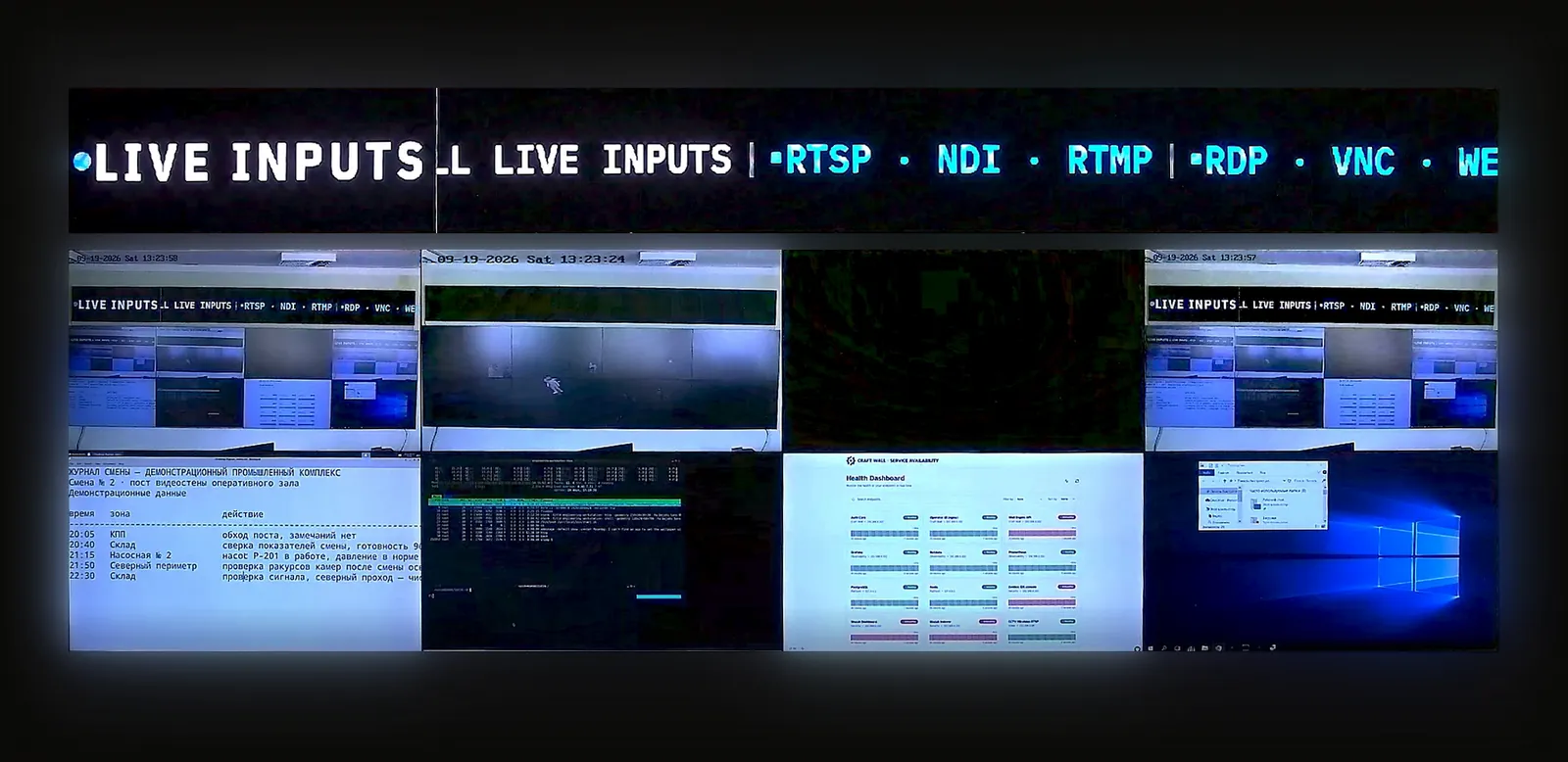
Le second projet est un mur d'exploitation MCR ou PCR secondaire autour du multiviewer : interfaces web d'encodeurs, télémétrie CDN, files de transmission, flux de confidence off-air, tableaux de bord de supervision, outils sociaux/d'audience, et panneaux d'incident. Pour cette charge de travail, un mur logiciel est une alternative légitime à l'extension du parc de multiviewers hérités, car la plupart des sources sont du navigateur, du RTSP, du NDI, de la capture HDMI ou de l'IP-KVM plutôt que des entrées de signal baseband natives.
- Conservez le matériel Evertz / Imagine là où la correction du signal est le livrable. Le QC à l'antenne, le loudness légal, la supervision de l'installation ST 2110 et les preuves de SLA appartiennent à la chaîne primaire.
- Utilisez le logiciel là où le contexte opérationnel est le livrable. Tableaux de bord, outils web, confidence off-air, vues post-QC et état des incidents tirent davantage profit de dispositions flexibles et d'un TCO plus bas que d'une carte de multiviewer fixe supplémentaire.
- Reliez délibérément les deux niveaux. Affichez la sortie du multiviewer ou de la sonde en amont comme une source de confidence approuvée sur le mur logiciel, puis entourez-la des vues opérationnelles dont l'équipe broadcast a besoin.
La supervision broadcast définie par logiciel en 2026
Trois changements structurels ont fait basculer l'équilibre ces trois dernières années :
- Le mix de sources a quitté le SDI. Confidence d'encodeurs, tableaux de bord de transmission, portails CDN, supervision sociale — aucune de ces sources n'est du SDI. Ce sont des interfaces web, des flux RTSP, des API REST rendus en tableaux de bord. Les multiviewers matériels qui excellent en SDI apportent ici peu de valeur.
- NMOS a atteint la production. La découverte NMOS IS-04 et la gestion de connexion IS-05 sont devenues la couche de gestion par défaut des installations ST 2110. Les murs logiciels qui parlent NMOS peuvent prendre place sur un bus NMOS aux côtés du reste de l'installation.
- Premiers produits certifiés IPMX à l'ISE 2026. Voir l'article IPMX vs ST 2110 vs SDVoE pour le détail des standards. La conséquence pratique pour le broadcast : le transport de la famille ST 2110 tourne désormais sur une installation 1 GbE avec compression JPEG XS, et la frontière entre installation broadcast et salle de contrôle ProAV commence à s'estomper. Les murs de supervision capables d'ingérer l'IPMX couvrent les deux mondes.
Le résultat est un mur à deux niveaux comme norme émergente : une section de multiviewer matériel pour la supervision primaire signal-correcte, et une section définie par logiciel pour tout le reste, les deux physiquement sur la même surface murale, l'opérateur se moquant de savoir quel niveau a rendu quelle tuile.
Que spécifier pour chaque niveau
Un vocabulaire d'appel d'offres qui produit régulièrement le bon résultat :
Pour le niveau QC primaire : exigez une entrée native ST 2110-20/-30/-40, la conformité NMOS IS-04 + IS-05, une détection de lipsync conforme à ITU-R BT.1359, une mesure de loudness selon ITU-R BS.1770 (avec ATSC A/85 ou EBU R128 comme profil aval selon le territoire), des seuils de détection de freeze et de black avec un temps de réponse infra-trame, et une supervision de l'état EAS le cas échéant. Spécifiez un multiviewer matériel ou un stack logiciel avec déport FPGA explicite — et demandez des références de déploiement dans un niveau et un territoire correspondants.
Pour le niveau exploitation secondaire : exigez un mélange flexible de sources couvrant au moins NDI, NDI HX, RTSP, capture HDMI et sources web rendues en navigateur. Spécifiez une surface de contrôle opérateur (le navigateur est la norme moderne ; contrôle par tablette ou écran tactile en complément), la persistance des dispositions d'une équipe à l'autre, un accès basé sur les rôles avec journal d'audit, et une API REST ou WebSocket pour le changement automatisé de disposition piloté par l'automatisation de diffusion ou la réponse aux incidents.
Pour les deux niveaux : une capacité d'air-gap si l'installation porte du contenu d'infrastructure critique ou gouvernemental, une compatibilité IPMX sur un calendrier de feuille de route annoncé, et un TCO publié sur au moins cinq ans incluant le renouvellement logiciel, le remplacement matériel et les paliers d'escalade du support.
Où Craft Wall s'inscrit dans une installation broadcast
Périmètre honnête : Craft Wall se situe dans le niveau opérationnel secondaire d'une installation broadcast, pas dans le niveau primaire de QC du signal. Il convient pour :
- Murs d'exploitation MCR. Tableaux de bord d'encodeurs, état de la file de transmission, télémétrie CDN, rotation de confidence off-air, panneaux de réponse aux incidents, supervision sociale et d'audience pendant les événements en direct.
- Murs de salle de transmission. État des liaisons satellite, posture de redondance, tables multicast et PIM, panneaux NMS de transport.
- Murs de support de studio. Flux des intervenants, miroirs de prompteur, fils sociaux pour les présentateurs, références hors-studio pour les régisseurs de plateau.
- Murs de support de véhicule de reportage (OB). Supervision secondaire depuis un serveur Linux standard équipé d'un GPU NVIDIA installé dans le car-régie, à côté de la baie de multiviewer FPGA primaire.
- Murs de salles de post-production et de montage. Moniteurs de référence, télémétrie de la ferme de rendu, tableaux de bord de gestion des médias.
Non approprié, en 2026 : la supervision primaire signal-correcte à l'antenne d'une installation ST 2110 exigeant une mesure infra-trame de lipsync et de loudness. Pour ce niveau, un stack Evertz VIP, Tag Video Systems, Telestream Sentry, Cobalt Digital ou Telestream PRISM reste le bon outil, et Craft Wall se place un niveau en aval, affichant les sorties de sondes et les tableaux de bord sur le mur opérationnel.
Arbre de décision d'acquisition
Trois questions tranchent la plupart des décisions de mur de supervision broadcast :
- Ce mur porte-t-il des preuves de conformité ? Oui → multiviewer matériel pour le niveau conformité, mur logiciel pour le reste. Non → le mur logiciel s'en charge.
- Le mix de sources est-il majoritairement SDI / ST 2110 ou majoritairement IP / web ? Majoritairement SDI / ST 2110 → le multiviewer matériel mène, le mur logiciel en appoint. Majoritairement IP / web → le mur logiciel mène, le multiviewer matériel en option pour d'éventuelles poches de conformité.
- Quel est l'horizon de TCO sur 5 ans ? Les multiviewers matériels se renouvellent sur un cycle de 7 à 10 ans avec un CAPEX substantiel par châssis. Les murs logiciels se renouvellent au rythme des cycles du matériel serveur standard, avec une licence logicielle perpétuelle ou par écran. Voir la décomposition du TCO pour le calcul comparable en contexte de salle de contrôle — la même structure s'applique aux murs secondaires broadcast.
À lire ensuite
Pour la colonne vertébrale des standards qui anime tout cela, voir IPMX vs SMPTE ST 2110 vs SDVoE. Pour le cousin des murs opérationnels dans un autre secteur, l' architecture de référence NOC documente le mix de sources et la bascule pour un NOC télécom à échelle comparable — une grande partie de l'ingénierie du niveau secondaire se transpose. Pour la question du cloud hybride que se posent de nombreux diffuseurs — où s'arrête l'installation et où commence le cloud — l'article architecture de mur d'images en cloud hybride répartit les responsabilités. Pour le vocabulaire de sécurité et d'audit dans des installations broadcast réglementées ou du secteur public, ajoutez le guide de conformité des murs d'images au dossier d'acquisition.