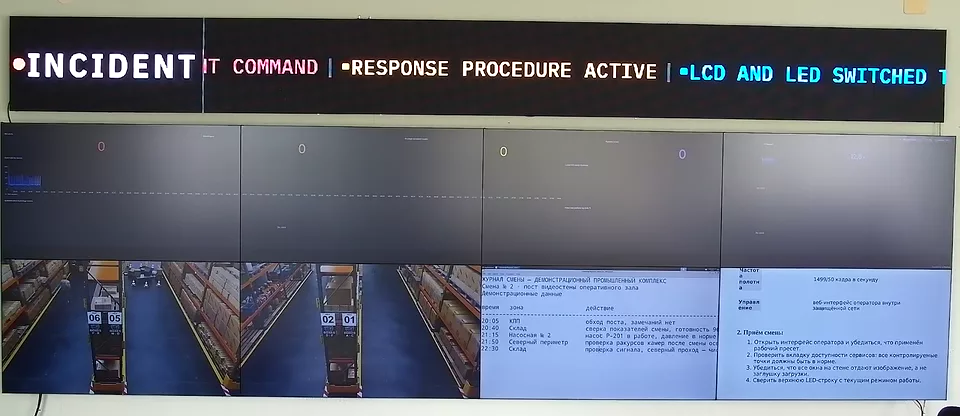
In short
In France and across the francophone market, urban supervision centers (the centre de supervision urbain, or CSU), site security desks (PC sécurité), and broader hypervision platforms now run their shared operational picture on a video wall. But the wall is not the hypervisor. It is the visualization layer. This guide explains where a software-defined wall fits a CSU or hypervision stack, the source mix it has to absorb, how it integrates beside a PSIM or hyperviseur, and the sovereignty constraints that decide French public-sector procurement.
Supervision, hypervision, and the CSU
Supervision watches one system. Hypervision federates many. A French hyperviseur de supervision pulls videosurveillance, intrusion, fire detection, access control, and building management (GTB/GTC) into a single operator interface, correlating events across all of them. The centre de supervision urbain is the municipal command room where that federation runs for city vidéoprotection: hundreds of cameras, ANPR, patrol geolocation, and crisis coordination on behalf of a town or métropole.
The hyperviseur — typically a PSIM-class platform — is the correlation and workflow engine. The video wall is what renders the result so a room full of operators shares one picture. Treating them as the same product is the most common scoping error in CSU tenders, and it is why so many rooms end up with a rigid hardware controller welded to one vendor.
The wall is the visualization layer, not the hypervisor
Craft Wall does not replace your hyperviseur or PSIM, and it does not try to. It is the GPU-driven situation-room wall that displays everything the hyperviseur surfaces — camera matrices, GIS maps, alarm dashboards, web portals, RDP sessions — on a single canvas, controlled from a browser. The honest positioning for a CSU is precise: Craft Wall is la couche de visualisation de l’hyperviseur. The hyperviseur decides what matters; the wall shows it, instantly, to everyone in the room.
Because the wall is software on commodity Linux rather than a fixed-input controller, an alarm correlated by the hyperviseur can drive the wall directly: an event pushes the incident zone to half the wall, the related cameras beside it, and reverts to the working layout when the timer expires. No operator drags windows by hand during the seconds that matter.
The source mix in a city operations room
A CSU or PC sécurité wall has to absorb a wider mix than a NOC. Plan for all of it:
- CCTV / VMS — camera matrices over RTSP and ONVIF, often via NDI or AV-over-IP in newer builds.
- ANPR / LAPI and patrol geolocation overlaid on GIS cartography.
- Alarm dashboards — intrusion, fire, access control, and GTB/GTC technical alarms.
- Web portals and OSINT — traffic, weather, social feeds, and internal web applications as live browser sources.
Integrating a software wall with the hyperviseur
The integration question is never “does it replace our platform” — it is “how does the wall consume what our platform already produces.” For a software wall the answer is open ingest plus event triggers:
| What the hyperviseur produces | How the wall consumes it |
|---|---|
| Camera / VMS streams | RTSP, ONVIF, NDI capture |
| Correlated alarm / event | API / webhook → scene change |
| Dashboards, GIS, web portals | Embedded browser sources |
| Operator actions | Browser control, multi-operator, RBAC / SSO |
| Source failure | Per-source watchdog, self-healing reconnect |
Sovereignty and compliance (ANSSI, RGPD, SecNumCloud)
French public-sector vidéoprotection is governed by hard constraints, and they favor a software wall that runs entirely on-premises. RGPD applies to every camera feed and retention rule; ANSSI hygiene guidance shapes the architecture; and a sovereign posture usually means no cloud call-home and, for the most sensitive rooms, an air-gapped deployment. Craft Wall runs on commodity Linux with no proprietary controller and no mandatory cloud dependency, which is exactly the posture a CSU procurement asks for. The compliance guide maps the full regulatory surface.
Sizing and operator workflow
The number and resolution of displays are bounded only by the server's GPUs and video outputs, and several operators work the same wall from their own browsers in parallel, each change synchronized instantly. Scenes, per-source control, and event automation replace the manual window-shuffling of a fixed controller. The sizing guide covers how source count and display count drive the server specification, and the command-center guide covers the higher-assurance C4ISR variant.