In short
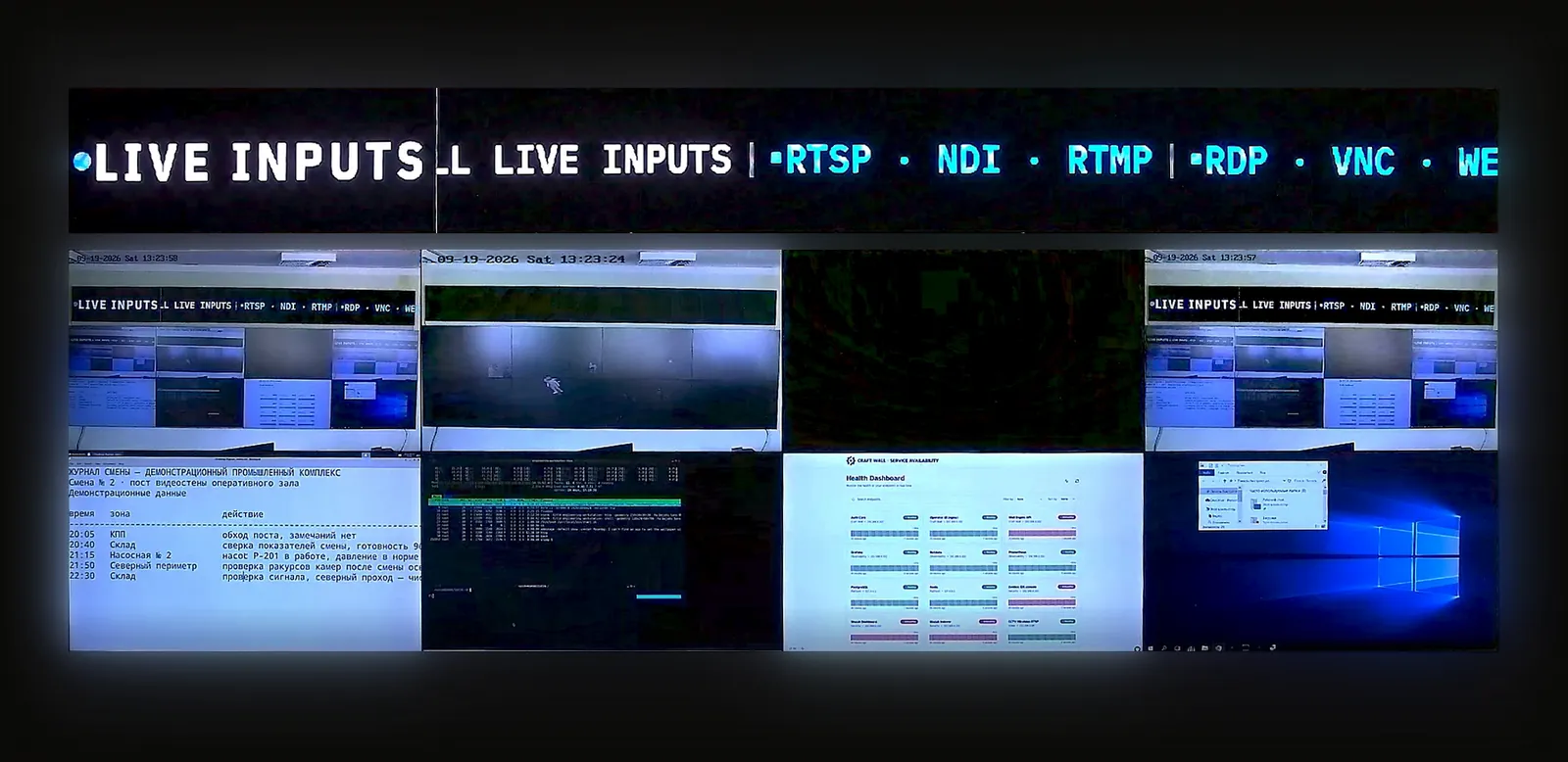
A video wall in Canada rarely fails on the displays — it fails on the controller economics and the procurement constraints around it. This is a buyer-side guide to specifying a software-defined video wallfor Canadian control rooms, NOC/SOC, operations centres, broadcast monitoring, and corporate AV: budgeted in Canadian dollars, specified for Quebec's French-language requirements, on-premises for data residency, and running on commodity Linux servers with NVIDIA GPUs, with no per-display subscription.
Where video walls run in Canada
The Canadian market for control-room and video wall software is concentrated in a handful of operational segments rather than one generic use case. The strongest commercial fits are:
- Utility and energy operations centres — hydro, gas, and renewables dispatch across Ontario, Quebec, BC, and Alberta, where SCADA read-only views, outage maps, and CCTV share one wall.
- Transit and transportation management centres — metro, bus, and highway operations in Toronto, Montreal, Vancouver, and Calgary, mixing CCTV, passenger-flow dashboards, and incident boards.
- Broadcast and media monitoring — Canada has a deep broadcast base; multiviewer-style monitoring walls fit master-control and quality monitoring.
- Enterprise NOC and SOC — telecom, managed-service, and data-centre operators running 24/7 network and security monitoring.
- Corporate AV — lobbies, boardrooms, briefing centres, and executive dashboards in head-office towers from Toronto to Calgary.
- Higher education — campus operations, research visualization, and teaching walls at Canadian universities and colleges.
Budgeting in Canadian dollars, no per-display subscription
The line item that quietly dominates a Canadian five-year budget is per-display or per-source licensing. Craft Wall is a one-time perpetual licence listed at €2,500 per server (the price list gives about $3,700 CAD as a reference; the invoice currency is agreed in the project quote), with unlimited displays, sources, operators, and canvases — no recurring per-display fee. For a 16- or 32-display wall that difference compounds quickly against a subscription model.
Before you compare quotes, model the real number with the video wall TCO calculator and read the five-year software-vs-hardware TCO breakdown. A hardware controller's sticker price is rarely the cheapest option once capacity steps and the end-of-life refresh are included.
Bilingual operations and Quebec
Canada is a two-language market, and Quebec adds a legal dimension: control rooms operating in the province work under the French-language requirements of Bill 96. Treat French-language operation as a project requirement: the public site is available in French as well as English, but confirm the operator-interface language during the demonstration rather than inferring it from the website. Agree the French terms for layout names, source labels and documentation (for example, mur d'images, salle de contrôle, centre des opérations) with the operations team.
Data residency and on-prem deployment
Canadian buyers — especially in utilities, healthcare, education, and the broader public sector — often have policy or contract requirements to keep operational data inside the country. Craft Wall runs on-premises on your own Linux servers with NVIDIA GPUs and is air-gap compatible, so video, dashboards, and operational data stay on Canadian infrastructure. There is no mandatory cloud control plane, so the wall does not require a cross-border transfer. PIPEDA permits processing outside Canada but keeps the organization accountable for it, and provincial laws set their own conditions (FIPPA in Ontario; FOIPPA in British Columbia, whose strict data-residency rule was repealed in 2021; PHIPA for health information in Ontario; and provincial equivalents).
For deployments that must be fully isolated, the air-gapped and sovereign deployment guide covers the offline-update and hardening pattern.
Specification checklist for Canadian buyers
- Budget and compare in CAD across five years, not on acquisition cost alone — include per-display licensing, refresh risk and the invoice currency of each quote.
- Confirm on-prem / air-gap operation and that no cloud dependency is required for day-to-day use.
- Require bilingual EN/FR operation if the site is in Quebec or serves federal bilingual obligations.
- Treat browser dashboards, RTSP / NDI cameras, and IP-KVM as first-class sources, not add-ons.
- Specify named layouts per operating mode and operator-controlled source promotion with audit.
- Decide between licence-only and a turnkey pre-configured server — see the turnkey video wall project guide.
For the vendor-neutral shortlist, see the best video wall software in 2026, and for the operations-centre layout pattern, the command centre video wall guide.